ChatGPT
High-Collar Fashion Portrait
Written for ChatGPT. Results and reference-photo support may differ across models.
The complete prompt
Create an authentic 1964 fashion photograph using the uploaded photograph as the EXACT identity reference. Preserve the exact face, facial proportions, eyes, nose, lips, skin tone, natural asymmetry, and recognizable identity.

THE VIBE

A highly fashionable young woman in the early-to-mid 1960s, photographed on a bright morning like an authentic European fashion portrait from that era.

She is standing confidently and looking directly into the camera. One hand rests naturally on her waist, creating an elegant model-like silhouette. The photograph is cropped from approximately the chest upward — close enough to feel intimate, but not a tight headshot.

Her expression is confident, calm, slightly serious, effortlessly fashionable.

HAIR — MAJOR FOCUS

Give her very full, naturally frizzy, deliberately arranged 1960s hair.

The hair should look professionally styled but slightly unruly: enormous soft volume, lifted roots, loose flyaways, irregular curls and waves, slightly messy texture, fluffy edges, and individual strands escaping around the face.

It should look like fashionable 1960s salon hair that has been carefully arranged for a model, rather than modern perfectly controlled hair.

No sleek modern straightening.
No contemporary beach waves.
No glossy modern hairstyle.

OUTFIT

Use an authentic 1963–1965 European high-fashion silhouette, NOT a denim jacket and NOT a coat.

She wears a beautifully structured high-collar sleeveless or short-sleeved shift-style dress with a dramatic contrasting collar.

The dress should have:

- a clean geometric 1960s silhouette
- a fitted upper body that naturally follows her shape
- a slightly structured waist
- an elegant straight/soft A-line fall
- a large sculptural contrasting high collar
- strong two-tone color blocking
- subtle period-appropriate geometric detailing
- fine vintage fabric texture

Think Swinging London / Paris boutique fashion, but sophisticated rather than costume-like.

The collar should be one of the visual signatures of the outfit — tall, crisp, graphic, and contrasting strongly against the main dress color.

No jeans.
No denim.
No leather jacket.
No modern blazer.
No coat.

BODY & POSE

Natural feminine proportions with a realistic 1960s fashion-model silhouette.

One hand rests on her waist.
The other arm remains naturally relaxed and mostly outside the crop.

Shoulders slightly angled.
Head turned only subtly toward the camera.
Direct eye contact.

The pose should feel like a real fashion photograph, not a modern influencer pose.

BACKGROUND

A quiet elegant European street or refined Parisian building entrance in the morning.

Period-authentic architecture and surroundings.
Soft morning sunlight.
No modern cars, signs, buildings, phones, or contemporary objects.

Keep the background understated so the face, hair, collar, and silhouette dominate.

CAMERA & FRAMING

Vertical 9:16.
Chest-up composition.
Slightly off-center framing.
Eye-level camera.
Natural photographic perspective.
Medium-close portrait rather than an extreme close-up.

OLD CAMERA LOOK — VERY IMPORTANT

Make this look as though it was actually photographed in 1964 with a very old film camera.

The image should be noticeably soft and somewhat blurry, more than a normal vintage photograph.

Use:

- imperfect manual focus
- low optical resolution
- soft facial detail
- gentle motion softness
- slight lens haze
- weak edge definition
- subtle exposure imperfections
- natural coarse film grain
- mild focus inconsistency

The face must remain recognizable, but do not make the eyes or hair digitally sharp.

The softness must feel optical and photographic, never like a digital blur filter.

FILM & COLOR

Very old, faded photographic color.

Muted burgundy, cream, dusty blue, faded mustard, soft black, warm beige, and slightly yellowed highlights.

Low contrast.
Soft blacks.
Reduced saturation.
Uneven fading.
Subtle age-related color shifts.

Add a little grainy texture throughout the image — clearly visible when viewed closely, but still natural to old film.

PHYSICAL OLD-PHOTO CONDITION

Make it look like a real printed photograph that has survived since the 1960s.

The photograph has irregularly deteriorated edges:
torn paper fibers, scraped emulsion, chipped corners, tiny cracks, worn patches, faded sections, and uneven deterioration around the perimeter.

Some damage can slightly intrude into the photograph.

NO straight white border.
NO clean rectangular frame.
NO perfect digital photo border.

The edges should look physically torn, scraped, aged, and imperfect.

FINAL FEEL

The result should feel like discovering a rare 1964 fashion photograph inside an old family album.

Extremely fashionable for its era.
Very feminine and elegant.
Voluminous frizzy arranged hair.
Graphic high-collar contrasting dress.
Confident hand-on-waist pose.
Soft old-camera focus.
Noticeable film grain.
Faded 1960s colors.
Physically damaged photographic paper.

It should feel authentic enough that it looks like the photograph was actually taken in 1964 — not a modern portrait with a vintage filter.

NEGATIVE INSTRUCTIONS

No denim, no jeans, no denim jacket, no coat, no modern clothing, no modern hairstyle, no sleek contemporary hair, no smartphone look, no DSLR sharpness, no HDR, no ultra-clean skin, no digital sharpening, no artificial blur, no modern color grading, no glossy fashion-editorial finish, no CGI, no illustration, no modern architecture, no straight white border, no clean rectangular frame, no perfect photo-frame effect.
Copy the complete prompt and use your own reference photos where requested.
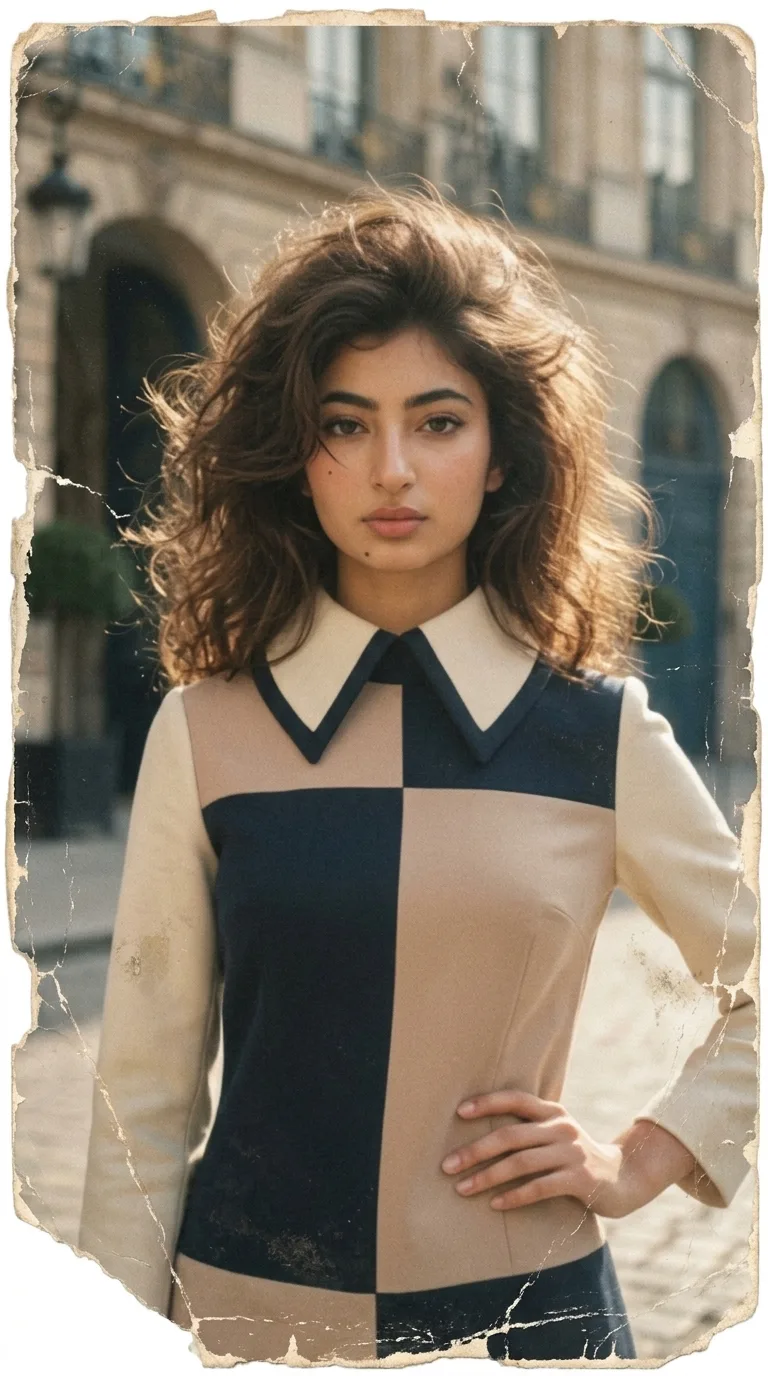
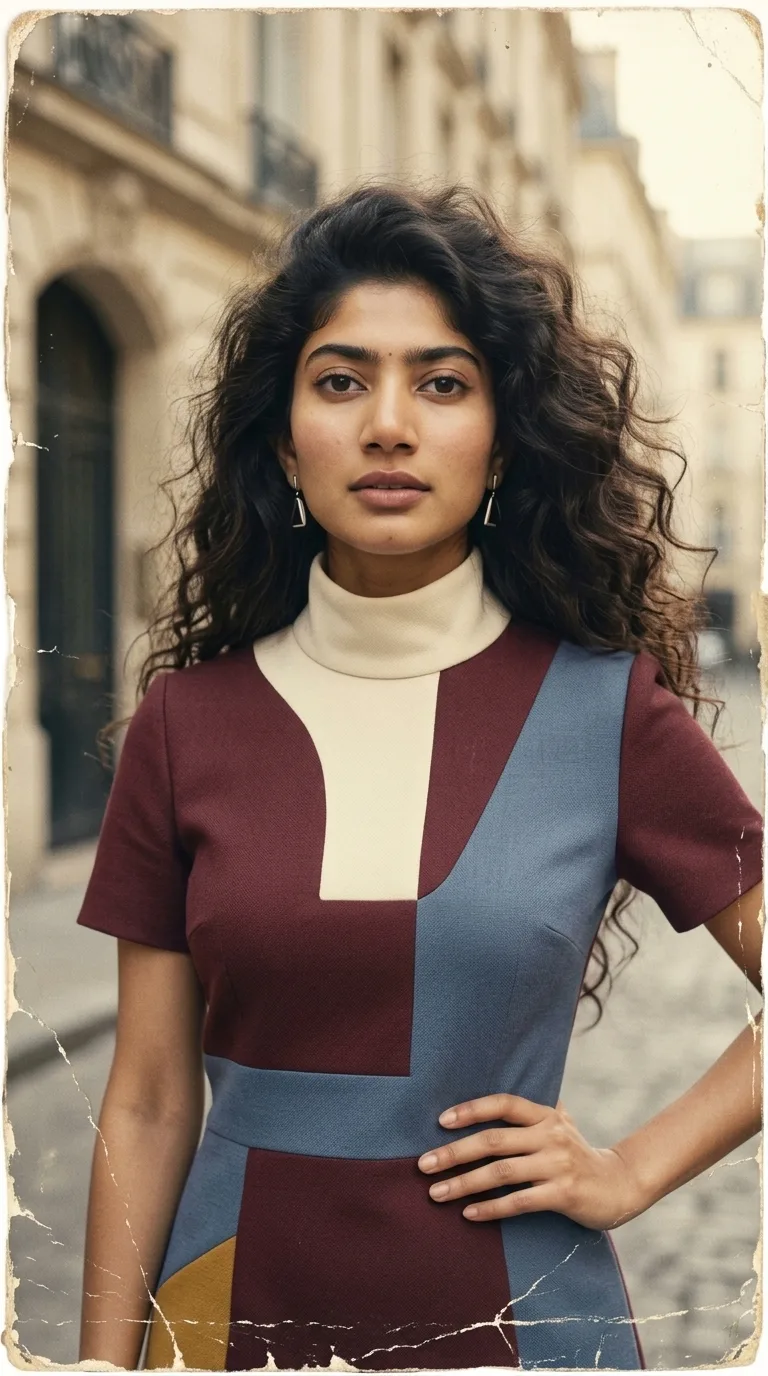
Example image provided with this prompt. This prompt has not been tested by our site.